
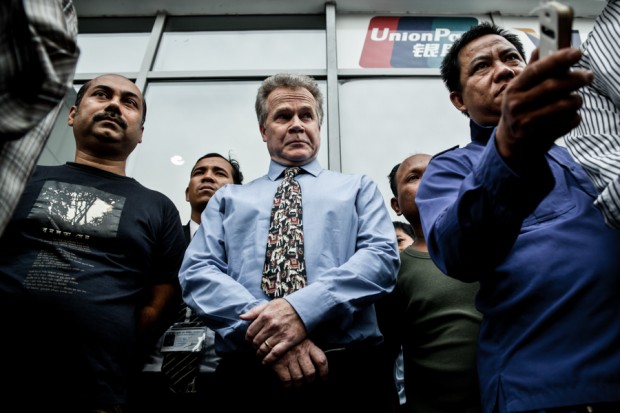
Last week, we filmed the above video about the ongoing struggle of Cambodian garment workers at Kingsland garment factory in Phnom Penh. It’s getting a decent chunk of shares online from people around the world who are pretty appalled at what they’re seeing – 200 women at the bottom of the fashion supply chain speaking up about why they haven’t received full wages since September, why they’ve been sleeping on the street for almost a month, and why they need Walmart and H&M to act.
When H&M was notified last week about the situation at Kingsland, a local representative responded by saying that:
“Kingsland is not [an] H&M factory…”
Hmmm.
Despite their certainty that Kingsland was not an H&M factory, H&M went on to say that they would do an investigation. It can’t hurt to check, right? It turns out that after playing detective, H&M discovered that the factory has supplied their company. But they were quick to emphasize that the business relationship with Kingsland ended in June 2012 – and that was supposed to shut us up.
Here was the next response made by H&M, after loads of angry customers reposted the video to the H&M Facebook page:
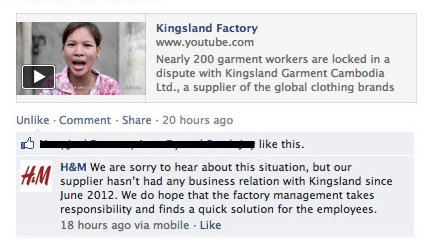
In short, they hope someone else picks up the pieces and we all forget that H&M was ever involved.
Interestingly, there seems to be some disagreement on when the business relationship actually ended. While H&M continues to copy and paste that there wasn’t any relationship with Kingsland since June, workers say they only started producing H&M clothes in June – they didn’t finish with the products until September, about a week before the factory first suspended operations. Not only that, they say they were slammed so hard with orders during that period that they worked 12 hours a day and they weren’t even allowed out of the factory on their lunch break.
What’s clear at least is that H&M has admitted that Kingsland was producing for them. So why did they initially say it wasn’t their factory?
According to a representative from the H&M’s Corporate Social Responsibility Department, Kingsland was subcontracted by a different H&M supplier factory to do the work without H&M’s knowledge. He said that until the women started making noise, H&M had no idea that Kingsland was even being used to make their clothes, and as such, H&M has no economic liability toward the workers.
Should we accept this?
H&M is the proud author of this little piece of paper called a Code of Conduct. It lays down the rules that their supplier factories should abide by. Some of these rules are pretty straightforward: follow the law and international labor norms, pay wages regularly, etc.
But don’t let this code trick you into thinking that the rules are strictly enforced. Despite the fact that this code is used by H&M to promote their reputation as a ‘leader’ in corporate social responsibility, the code itself says that “repeated serious violations” by factories ‘may’ lead to reduced business. Not ‘will.’ May.
What makes this document even more worthless, is that it turns out that H&M sometimes can’t even keep track of which factories are producing for them. I imagine that makes it pretty difficult for H&M to know what’s happening inside, let alone enforce any kind of order.
H&M’s code also says that their supply factories are obliged to “keep H&M informed at all times of where each product is being produced, including subcontracting.” If H&M wasn’t informed that their supply factory was subcontracting to Kingsland, H&M has a right to be angry. But they definitely shouldn’t be surprised. Unauthorized subcontracting isn’t anything we haven’t seen before. Walmart and Sears both claimed ignorance of subcontracting to avoid responsibility for the death of more than 100 women during the factory fire in Bangladesh late last year. Is anyone comforted by the fact that some of the most powerful companies in the world have no idea where their merchandise is being made?
Whether or not H&M can actually keep track of where their own clothes are being produced, H&M’s Code of Conduct explicitly states that its rules apply to all of their suppliers, including subcontractors, and that H&M has a “responsibility towards everyone who contributes to our success.”
It’s simple. Part of the workers’ claim is for lost severance and indemnity. Have workers accrued (unpaid) benefits while producing clothes for H&M? Yup. Have Kingsland workers ‘contributed’ to H&M’s success? For sure. Is H&M any less responsible because Kingsland was subcontracted to do the work? H&M’s very own Code of Conduct would suggest otherwise.
So what is this code even worth?
If H&M doesn’t act here, it’s all the proof needed to show that their Code of Conduct isn’t worth the paper it’s written on. And we’re forced to demand that H&M explain: what exactly does the word “responsibility” mean to them? According to their recent (in)action, responsibility simply seems like something to be avoided at all cost.
At very least, H&M needs to take action on the direct supplier. But they also have a serious opportunity to compensate the Kingsland workers and gain a reputation as a socially conscious buyer. If social consciousness is too big of a stretch, then why not do it as a clear business strategy to be better than the opposition? Or to put it another way, make Walmart look like trash in comparison.
If all of that is still not enticing enough, then why not do it to appease consumers who are appalled by this – consumers who continue to repost the video demanding that H&M really does something. The longer H&M waits, the longer Kingsland women are hungry on the street – making it likely that more and more customers will officially strike H&M from the list of places they can shop without feeling queasy.
Out of the 200 Kingsland workers that have stood up, some have been at the factory for over 10 years. On average, each worker is owed around $1200 USD, depending on their years of service. Compensating them is surely cheaper than losing customers for life.


Extremely powerful and moving, I cannot imagine what those women must be going through. I imagine the factory owner will not return, his business has seemingly failed? As far as the large corporations are concerned I wonder if they feel it is their responsibility, given that the factory owner has fled and quite likely had contracts via a sub contractor. As you quite rightly mention H&M code of conduct does state that responsibility is taken for sub contractors, but when a business fails which financially and legally has nothing to do with H&M, I wonder if they will see it as their responsibility to help these poor garment works. Perhaps H&M fear that setting a precedence to help these workers may leave them legally open in future scenarios?? There may be a number of reasons why the factory owners business has failed and it may well link back to the large corporations pushing to have goods made at low prices? The factory may have been forced to produce garments too cheaply. Factories do this on occasions to secure work so they can keep the factory running efficiently and keep the workers in a job. Long term contracts that secure a factories work flow rarely exist between corporations and factory owners. It can be very hand to mouth survival. Some factories may believe it is better to have the work while it is on offer and make the goods for no profit than turn it down and risk not getting more in future. This method is very risky and not sustainable. Unfortunately for the workers in Cambodia their plight is not very black and white because the supply chain is complex and has more people involved than it would first seem. I believe the key is cost. If a pricing standard is set up front, one that is more transparent to the corporation and factory then perhaps a garment can be produce more fairlypriced for the worker/factory owner and the corporation. This may lead to increase pricing and the consumer should be aware of this. We want fair working conditions for the workers around the world but are we as a consumer prepared to pay?? The consumer and large corporations need to re-educate themselves when it comes to pricing structures. Cheap is not sustainable and certainly not going to help workers like these in Cambodia.
I hope that something is done to help these workers. We can all do something by avoiding buying clothes that are cheap from all retailers, change the way we think about fashion and the environment, buy better not more of.